Last updated October 15, 2026
ADU Cost Breakdown: The San Francisco Homeowner’s Reference for 2026
The $350-per-square-foot figure you’ll see in most ADU cost articles is based on projects in Sacramento and Fresno. In San Francisco, the honest all-in number starts at $500 per square foot and routinely reaches $650 before anyone touches landscaping or furnishings. This guide and our complete guide to ADU in San Francisco explain why San Francisco ADU costs run 20 to 35 percent higher than national averages, break the total into nine line-item categories with real 2026 price ranges, and give you the numbers to build a budget that actually holds when the permits land and the foundation crew shows up.
Quick Answer
An ADU in San Francisco costs between $500 and $650 per square foot all-in for 2026, meaning a 600-square-foot one-bedroom unit runs $300,000 to $390,000 while a 1,000-square-foot two-bedroom runs $500,000 to $650,000. Prefab ADUs from brands like Abodu and Dvele land 10 to 18 percent below site-built on flat lots but those savings erode on San Francisco’s steep and constrained sites. A properly permitted ADU in San Francisco renting for $3,200 to $3,800 per month breaks even in 7 to 10 years before appreciation.
Table of Contents
- The Nine Line-Item Costs of a San Francisco ADU
- Four San Francisco Cost Drivers National Guides Ignore
- Prefab vs. Site-Built: The Real SF Cost Gap
- How Financing Method Changes Your Total Project Cost
- Break-Even and ROI at Three San Francisco Rental Price Points
- The Permit-to-Key Timeline in San Francisco
- Common Mistakes to Avoid
- When to Call a Professional
- Frequently Asked Questions
- The Bottom Line
The Nine Line-Item Costs of a San Francisco ADU
Every ADU budget, whether it’s a garage conversion in the Sunset or a detached rear-yard unit in Bernal Heights, breaks into the same nine categories. What changes between neighborhoods is the size of each line item. Here are the 2026 numbers as we see them on active San Francisco projects:
- Design + Engineering: $18,000 – $45,000. Architectural drawings, structural engineering, title-24 energy calculations, and survey work. San Francisco requires soil reports on most lots with slope, and many hillside parcels in Noe Valley and Twin Peaks trigger geotechnical review that flatland projects in the Richmond never see. Prefab brands like Dvele and Plant Prefab bundle their own engineering, which can trim this line item to the low end of the range.
- Permits + Impact Fees: $15,000 – $38,000. San Francisco’s Department of Building Inspection (DBI) plan-check fees, school impact fees, and the city’s inclusionary housing fee (if it applies to your project type). A detached ADU under 750 square feet typically carries lower impact fees than a JADU or a large addition. Our written estimates always itemize every fee so you see exactly where this money goes before you sign anything.
- Site Prep + Foundation: $30,000 – $80,000. Excavation, shoring on sloped lots, concrete or pier-and-grade-beam foundations, and any required retaining work. San Francisco’s soft clay and sand soils in the Marina and Sunset push foundation costs to the high end. On a steep lot in Diamond Heights, a full rear-yard ADU may need $40,000 in additional shoring alone. This line item is where national guides most often miss by 40 percent or more.
- Framing + Envelope: $45,000 – $95,000. Wall framing, roof structure, windows, exterior doors, siding or cladding, roofing, and weatherproofing. Prefab manufacturers including Boxabl and Mighty Buildings fabricate wall and roof panels in a factory, which changes this line item from field-framed to panelized install. For a site-built ADU, quality James Hardie fiber-cement siding adds roughly $12 to $16 per square foot over basic stucco.
- MEP Rough-In: $25,000 – $55,000. Plumbing supply and drain lines, gas line extension or new meter, electrical subpanel and wiring, and HVAC rough-in. If your PG&E service panel is only 100 amps, count on a panel upgrade and possibly a new service drop from the utility. SFPUC sewer lateral work, when triggered by the city, lands in this category and routinely surprises homeowners by $8,000 to $15,000.
- Finishes: $40,000 – $90,000. Drywall, paint, flooring, cabinets, countertops, tile, lighting fixtures, and bathroom fixtures. San Francisco’s labor market means finish carpentry and tile work run 20 to 30 percent above national averages. A mid-grade kitchen in a 600-square-foot ADU runs $22,000 to $30,000 all-in.
- Utility Connections: $10,000 – $25,000. New water service tap, sewer lateral connection or replacement, PG&E gas and electric hookups. If your ADU is detached and sits 50 feet or more from the main house’s panel, the cost climbs fast.
- Landscaping Restoration: $5,000 – $18,000. Putting your yard back the way you found it, plus drainage corrections. Excavation for a foundation and utility trenching tears up more ground than most owners expect. We include an explicit landscape restoration allowance in every written estimate, not a vague “as needed” line.
- Soft Costs: $8,000 – $20,000. Financing fees, title work if you’re tapping equity, owner’s title insurance, lender inspection fees, furniture and appliance purchases, and a contingency reserve. Smart owners hold 8 to 10 percent of the total budget in reserve for conditions nobody can see until the ground is open.
Add the midpoints together and a 600-square-foot detached ADU lands around $330,000. That’s $550 per square foot, and it matches what ADU builders in San Francisco quote on flat, accessible lots with existing utility capacity.
Four San Francisco Cost Drivers National Guides Ignore
Every national ADU cost article assumes a suburban lot in Texas or Ohio. San Francisco replaces that assumption with four line items that add real money and appear almost nowhere online:
1. DBI Plan-Check Fees and Re-Check Cycles
San Francisco’s Department of Building Inspection charges plan-check fees based on project valuation, not square footage. A $300,000 ADU triggers roughly $4,000 to $6,000 in DBI plan-check charges for the first round. If the reviewer sends the drawings back for corrections, each re-check adds $300 to $700. Most San Francisco ADU permit sets go through two or three re-check cycles. Budget $7,000 to $10,000 for DBI-specific plan-check costs alone, a line covered in our ADU Permits, Codes & Inspections in CA: What You Need to Know but missing from almost every national guide.
2. SFPUC Sewer Lateral Compliance
San Francisco Public Utilities Commission requires a sewer lateral inspection and often a full replacement before final sign-off on any ADU that changes water or sewer usage. A sewer lateral replacement under a San Francisco sidewalk runs $8,000 to $15,000 depending on depth and street conditions. On a pre-1950s home in the Outer Sunset, the old clay lateral almost always fails inspection. This is a mandatory cost, not an upgrade.
3. Seismic Upgrade Triggers
San Francisco’s soft-story and hillside ordinances require structural upgrades to the main house in some ADU scenarios, especially when converting a garage into living space. A garage conversion that removes lateral-wall capacity from the main structure may trigger shear-wall installation, hold-downs, and foundation bolting. Seismic retrofit work on the primary dwelling adds $15,000 to $40,000 to the project. If your home predates 1978 and you’re converting its garage, get a structural engineer’s opinion before you commit to a budget, and watch for ADU warning signs every San Francisco homeowner should know.
4. Union Labor Premiums on Major Trades
San Francisco’s commercial union agreements set prevailing-wage floors that influence residential labor rates, especially for electrical, plumbing, and concrete work. Finish-grade electricians in San Francisco bill $140 to $190 per hour, compared to $90 to $120 in Sacramento. A 600-square-foot ADU carries roughly $25,000 to $40,000 of labor premium just from being in San Francisco. National guides using blended national labor rates miss this by a wide margin.
Prefab vs. Site-Built: The Real SF Cost Gap
Factory-built ADUs from Mighty Buildings, Boxabl, and Plant Prefab are genuinely less expensive to build than stick-framed units on flat, accessible lots in San Francisco. The savings come from three places: factory labor rates that are 40 to 50 percent below San Francisco field labor, material bulk purchasing, and far less on-site time which cuts general conditions costs like portable toilets, fencing, and supervision.
A 600-square-foot one-bedroom from a quality prefab manufacturer typically runs $190,000 to $240,000 for the factory-built shell, delivered and craned to the site. Add San Francisco site work, foundation, utility hookups, and finishes, and the all-in number lands around $320,000 to $380,000. That’s roughly 10 to 18 percent below a comparable site-built unit.
But San Francisco’s geometry eats into that gap. Here’s what happens lot by lot:
- Flat, wide lot with crane access: prefab savings hold. You’ll pay $50,000 to $70,000 less than site-built.
- Narrow lot or tight setback: the crane may not fit. You pay $15,000 to $25,000 for a smaller crane, a longer reach, or street-closure permits from SFMTA.
- Steep lot: leveling the pad and building retaining walls for a prefab module costs the same as for site-built. Prefab’s savings drop to 5 to 8 percent.
- Garage conversion or attached ADU: prefab rarely applies. You’re site-building inside an existing envelope, and the cost drivers are structural, not fabrication.
We’ve built with panels from all three manufacturers mentioned above, and the honest guidance we give San Francisco owners is this: if your lot allows a crane and the pad is flat, prefab wins. If your lot slopes or sits behind the main house with no side access, the prefab premium may not be worth the logistics.
How Financing Method Changes Your Total Project Cost
The way you pay for an ADU in San Francisco changes the total cost of the project by tens of thousands of dollars over the life of the loan. Here are the four most common 2026 financing paths and what each one actually costs:
- Cash: $0 financing cost, but a large opportunity cost. Cash is cheapest on paper. You pay no interest, no origination fees, and no lender overhead. But tying up $350,000 in a construction project has an opportunity cost. If that money was earning in an index fund or a rental property elsewhere, your real cost is the return you gave up.
- HELOC or Home Equity Loan: 7.5 – 9.5 percent APR, interest-only during the draw period. Equity financing is the most common path for San Francisco ADU owners whose homes have appreciated substantially. A $350,000 HELOC at 8 percent costs roughly $28,000 per year in interest during construction if fully drawn. The total interest hit over a 15-year repayment is $230,000 to $260,000. The advantage: you retain full ownership and rental income without a construction-loan draw schedule.
- Construction Loan: 8 – 11 percent APR, interest accrues on draws only. Construction loans carry higher rates but you only pay interest on money actually drawn each month, not the full commitment. They also require a project cost breakdown from your builder and periodic inspections before each draw. A $350,000 construction loan at 9.5 percent with draws spread over 12 months accrues roughly $17,000 to $22,000 in construction-phase interest before conversion to permanent financing.
- California ADU-Specific Lender Products: 6.5 – 8.5 percent APR, designed for ADU construction-to-permanent. California now has a handful of non-bank and credit-union lenders underwriting ADU loans specifically, using the future rental income as part of the qualification math. Some offer construction-to-permanent conversion with a single closing, which saves $6,000 to $10,000 in duplicate closing costs. In 2026 these products represent the best blended rate for owners with strong credit and a finished project valuation above $500,000.
A quick rule of thumb for San Francisco: cash saves you the most on interest, a construction-to-permanent ADU loan costs you the least in fees, and a HELOC is best when your home equity is substantial and you want speed. Every lender will want a written project budget, which is exactly what we provide before signing day.
Break-Even and ROI at Three San Francisco Rental Price Points
A San Francisco ADU is a long-term asset. Here’s how the numbers run at three realistic 2026 rental points for a 600-square-foot one-bedroom unit that cost $330,000 all-in to build:
Scenario 1: $2,800/month rent
Gross annual income: $33,600. Subtract 5 percent vacancy, 8 percent property management, $2,400 annual maintenance, and an added $4,500 in property taxes and insurance. Net operating income runs $21,000 to $22,000. At a 6 percent capitalization rate, the unit adds $350,000 to $370,000 to your property value, which is right at the build cost. Cash-flow break-even before appreciation: 14 to 16 years. This scenario works best for owners building primarily to house family, not as a rental play.
Scenario 2: $3,500/month rent
Gross annual income: $42,000. Net operating income runs $28,000 to $30,000. At today’s cap rates, the unit adds $465,000 to $500,000 in property value. Appreciation break-even happens immediately; cash-flow break-even lands at 10 to 12 years. Refinancing an ADU at this rent level usually appraises above the construction cost, which lets you recapture most of your equity within a year of completion.
Scenario 3: $4,200/month rent
Gross annual income: $50,400. Net operating income runs $35,000 to $37,000. The unit appraises at $580,000 to $620,000, which means you’ve created $250,000 to $290,000 in equity over the build cost. Cash-flow break-even lands at 8 to 9 years. This is achievable in neighborhoods like Noe Valley, the Castro, and the Inner Richmond where one-bedroom rents consistently clear $4,000 in 2026.
Three data points to keep in mind: San Francisco rents bottomed in 2024 and have climbed every quarter since, vacancy rates for standalone ADUs remain below 3 percent, and a permitted ADU with its own address comps differently in an appraisal than an unpermitted conversion. If you’re deciding between finishing a basement and building a detached ADU, the permitted detached unit wins on appraisal math every time.
We make this point to every San Francisco owner we meet: an ADU that rents for $3,200 a month may not cover a construction loan payment in year one, but it builds equity from day one. That’s the tradeoff. If you need positive cash flow in the first year, build smaller or look at a JADU attached to the main home, where San Francisco’s reduced fee schedule helps the numbers work at a lower build cost.
The Permit-to-Key Timeline in San Francisco
San Francisco’s entitlement process is the slowest in California for ADU work, and that slowness has a dollar sign attached. Every month of delay is a month of carrying costs on any loan, and a month of lost rent at the back end.
Here’s what we tell San Francisco homeowners to expect in 2026:
- Design and engineering: 6 – 10 weeks. Site survey, architectural drawings, structural engineering, and title-24 documentation. Prefab ADU providers compress this phase because their plans arrive pre-engineered and need only site-specific adaptation.
- DBI plan check: 10 – 16 weeks. Over-the-counter review is a myth for most ADU projects. A state law mandates a 60-day review window for ADU applications, but DBI routinely uses the full allowance. This is where the re-check cycles we mentioned earlier add time and money.
- Other agency reviews: 4 – 8 weeks. SFPUC, SFMTA if you need a crane in the street, and the Planning Department’s zoning confirmation. Every agency runs on its own clock, and they do not coordinate.
- Construction: 16 – 24 weeks for site-built, 8 – 14 weeks for prefab panel installation. Prefab ADUs cut field time by half, which in San Francisco means less time paying for dust control, site fencing, and daily supervision.
- Final inspections and certificate of occupancy: 2 – 4 weeks. DBI’s final inspection queue moves faster than plan check, but you’ll still schedule two to four weeks out.
Realistic total: 12 to 18 months from first design meeting to keys. Owners who start in January and expect a tenant by summer are setting themselves up for disappointment. The smart move is to start the design process in the winter, accept that permits will take most of spring, and target construction completion in the following spring or early summer. For ongoing planning help, see our more guides & resources.
Common Mistakes to Avoid
- Budgeting from a national cost guide. The $350-per-square-foot figure is not a San Francisco number. Use the $500 to $650 range in this guide, and add 10 percent contingency on top of that. Your budget should survive first contact with DBI plan-check comments.
- Ignoring the service panel. A 100-amp PG&E panel cannot support a full ADU with electric appliances. Panel upgrades and new service drops add $8,000 to $20,000, and PG&E’s timeline can stretch three to six months. Check your panel amperage before you draw anything.
- Assuming your sewer lateral is fine. SFPUC inspects laterals on almost every ADU permit, and pre-1950s homes in the Sunset and Richmond fail at a high rate. Budget $8,000 to $15,000 for replacement and consider it a likely cost, not a contingency.
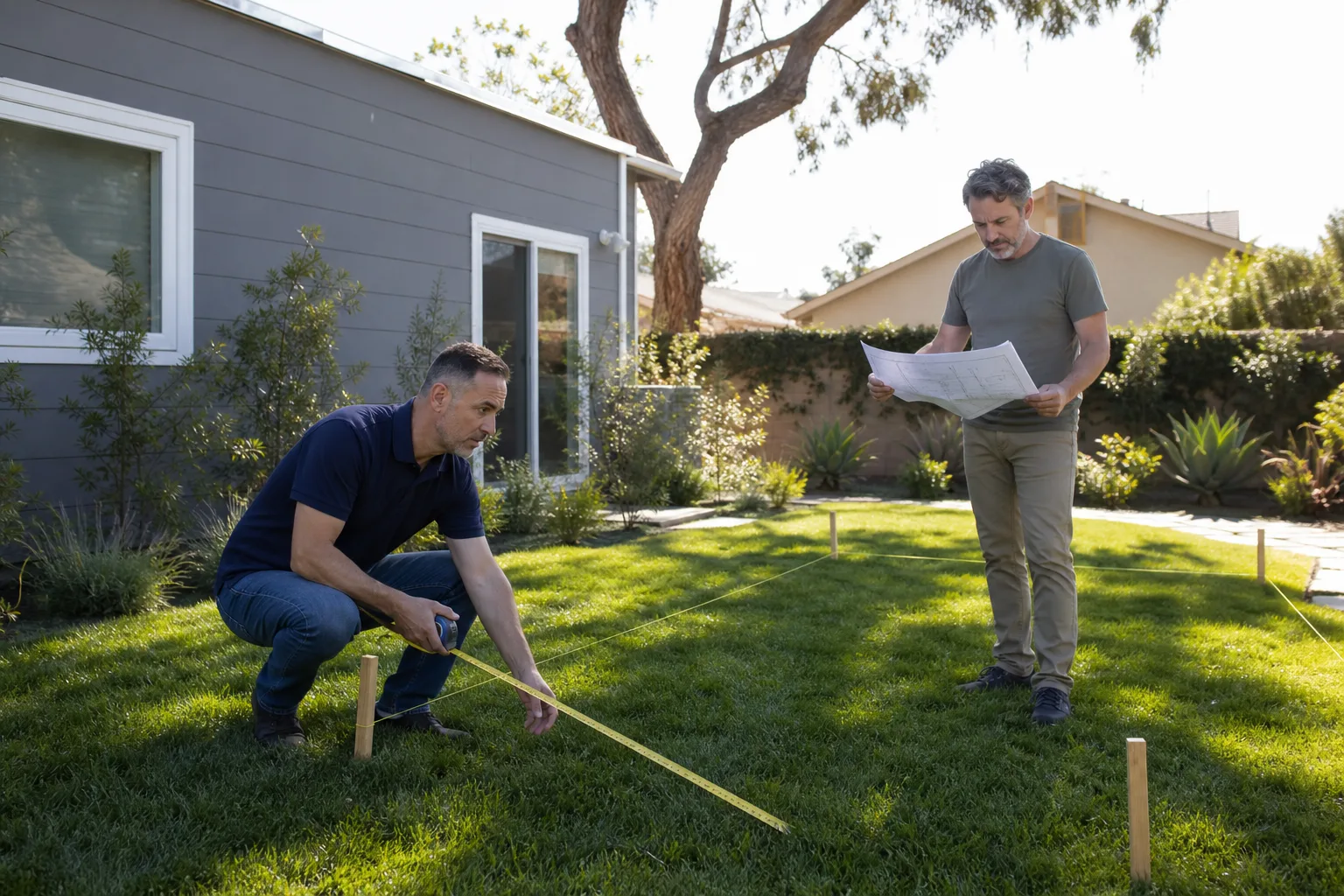
- Designing the ADU before checking the front yard. In San Francisco, the rear-yard setback and your lot’s slope determine what can actually be built. A design that looks great on paper may not fit after the required 4-foot side and rear setbacks. Survey first, design second.
- Comparing prefab quotes without putting both on paper. A verbal prefab estimate that omits foundation, crane, utility hookups, and site work looks $100,000 cheaper than a site-built quote that includes everything. Always get a written, all-in price from any builder, prefab or stick-built.
- Finishing the unit but not the paperwork. A finished ADU without a final certificate of occupancy is not rentable and not appraisable. Don’t stop inspections at “close enough.” Schedule the final inspection, pass it, and get the COO in hand.
- Skipping the contingency reserve. Every excavation in San Francisco finds something: a buried foundation, an old oil tank, a sewer line nobody mapped. Hold 8 to 10 percent in reserve and you’ll sleep through surprises.
When to Call a Professional
An ADU is not a weekend project and it’s not a handyman’s portfolio piece. If your lot slopes more than a foot, call a professional before you spend money on design. If your home was built before 1978, call a professional before you decide between a garage conversion and a detached unit, because seismic triggers may decide for you. If your service panel is 100 amps, call a professional to confirm what PG&E will require. And if you want a written price before any work starts, with a 365-day guarantee in writing, that is what we do. Benson ADU San Francisco offers free estimates in San Francisco. Call (424) 328-5746 and a live person will pick up, day or night.
Frequently Asked Questions
A detached ADU in San Francisco costs $500 to $650 per square foot all-in, meaning a 600-square-foot unit runs $300,000 to $390,000 and a 1,000-square-foot unit runs $500,000 to $650,000. Call (424) 328-5746 for an exact written estimate on your specific lot.
On flat, accessible lots, a prefab ADU from Plant Prefab or Boxabl typically costs 10 to 18 percent less than site-built. On steep or constrained lots, the savings shrink because foundation, shoring, and crane logistics cost the same regardless of how the walls are built.
It should not. Every project we price includes a written line-item budget before work starts, and our 365-Day Done Right Promise covers the completed work in writing. Any builder who won’t put the price on paper before demo day is asking you to take a risk you don’t have to take.
Yes. Every legal ADU in San Francisco requires DBI plan check, zoning confirmation, and final inspection sign-off. Unpermitted ADUs cannot be rented legally, cannot be appraised as living space, and create liability for the owner when sold.
Plan on 12 to 18 months from first design meeting to certificate of occupancy. DBI plan check alone takes 10 to 16 weeks in 2026, plus agency reviews from SFPUC and SFMTA. Prefab panel installation cuts construction time by about two months versus site-built.
Yes. A permitted, standalone ADU with its own address and certificate of occupancy can be rented at market rate. San Francisco allows both long-term rentals and furnished corporate rentals, and the rental income can be used to help qualify for some California ADU-specific loan products.
The Bottom Line
San Francisco ADUs cost more than the national numbers suggest, and they’re worth building anyway. A 600-square-foot unit at $330,000 all-in adds roughly that much to your appraisal on day one, generates $2,800 to $4,200 a month in rent depending on neighborhood, and breaks even in 8 to 15 years while building equity the whole time. The project only breaks your budget when the numbers were wrong from the start. Get a written estimate that includes DBI fees, SFPUC sewer compliance, seismic triggers, and union labor premiums. If you want that written price from a home addition contractor in San Francisco who puts the guarantee in writing too, call (424) 328-5746. We’ll walk your lot, talk real numbers, and hand you a budget that holds. Room additions and ADUs are what we do, and we do them with the price on paper first.
Written by Troy Eastman, Owner at Benson ADU San Francisco, serving San Francisco since 2006.